
Keyword Hijacking: The 90-Day Push to Take Back Your Search Results
If you are reading this, you already know the playbook by heart. You submitted the opt-out forms. You filed the take down requests. You emailed the site administrators and appealed to their better nature. Maybe you even sent certified letters or hired a service to scrub your data. And here you are, still watching your most damaging information sit on Page 1 like it owns the place.
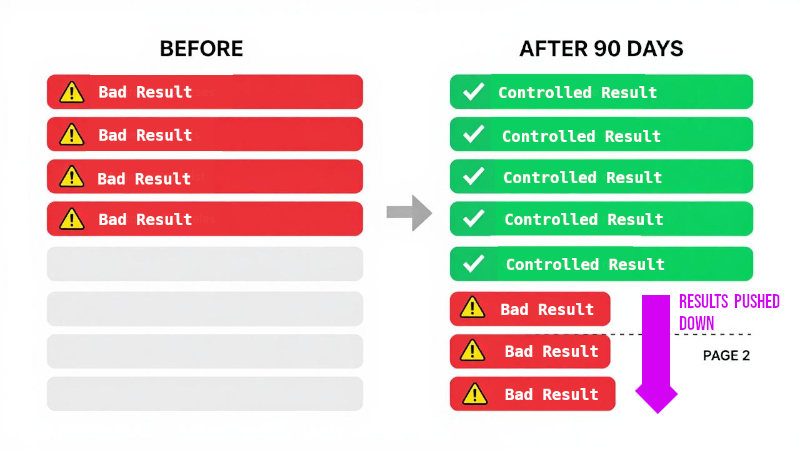
This article is Keyword Hijacking: The 90-Day Push to Take Back Your Search Results. That is the name of the game, and it describes exactly what you are doing. You are hijacking the search engine for your own narrative. The low-lowing fruit is gone. What remains is the hardened target: old legal records that expired but never disappeared, news coverage from a chapter of your life that no longer reflects who you are, forum posts from someone with a grudge, or data broker listings that treat your personal history like a product they will never stop selling.
Appeals do not work on these. Politeness does not work. Legal threats sometimes work, but they take years and cost fortunes you may not have. So we stop playing defense. This is about Keyword Hijacking — the core tactical weapon in Guerrilla Privacy. The philosophy is straightforward: if you cannot delete the damaging information, you bury it. You do not ask the algorithm to forget you; you teach it exactly what to remember instead.
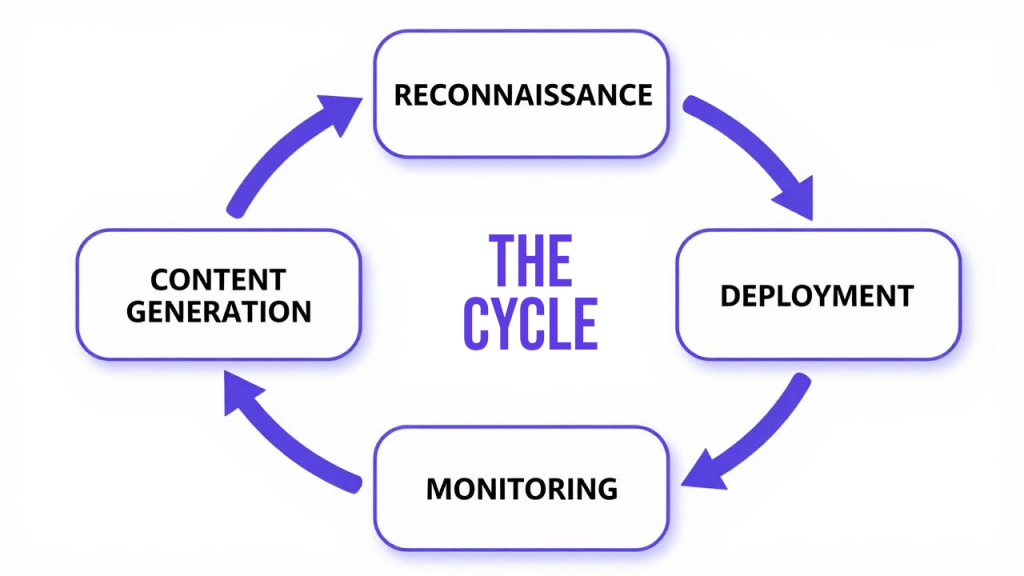
Phase 1: Reconnaissance — Mapping the Threat Landscape Across All Engines
You cannot fight an enemy you cannot see, and in the digital realm, your enemy is the invisible algorithm that decides what the world sees when they type your name. The reconnaissance phase is where you shift from passive anxiety to active intelligence gathering. This is not a quick Google search while on vacation. It is a systematic, automated audit of your entire digital footprint across every major search index.
For a high-threat model, manual checking is insufficient because threats emerge dynamically. New data broker listings pop up daily, old news archives get re-indexed with fresh signals, and negative forum posts can resurface due to algorithmic shifts. Relying solely on Google is a critical error. Attackers in different regions, or those using privacy-focused alternatives, may see entirely different results. You need a system that watches 24/7 across Google, Bing, DuckDuckGo, and any other engine relevant to your threat profile.
Defining Target Parameters
Your first step is cataloging every permutation of your identity that could be weaponized. This includes your legal name, common misspellings, professional aliases, former names, and combinations with your location, profession, or specific past events. If there was a legal case years ago, include terms like “arrest,” “case,” “lawsuit,” or “indictment” paired with your name. If you are worried about doxxing, include your city, neighborhood, or workplace if it is publicly linked to you.
Crucially, you must build a geo-spatial matrix. Do not just search “Name.” Search “Name City Arrests,” “Name County Records,” “Name State Complaints.” This granular approach catches vulnerabilities that generic searches miss.
The Multi-Engine Discovery Loop
Operating in a Linux environment, you leverage Python and Playwright, a modern browser automation library supporting Chromium, Firefox, and WebKit. Unlike older tools, Playwright spins up multiple isolated browser contexts within a single process, each with a distinct user agent, locale setting, and proxy endpoint. One context simulates a Firefox user from Berlin, another a Chromium user from Toronto. This diversification prevents search engines from recognizing the traffic as coming from a single automated source.
The core loop iterates through your target list against multiple engines. For each keyword combination, the script launches a fresh browser context, navigates to the search engine URL with encoded query parameters, and waits for results to fully render. Once stable, it extracts the top ten organic results using CSS selectors, skipping paid ads and local packs to focus on the standard blue-link results that determine Page 1 visibility.
Data is normalized and stored in a timestamped database. Each result records the query, rank, URL, domain authority estimate, and snippet text. If today’s scan shows a new URL appearing on Page 1 containing your name that was not there yesterday, that is a high-priority alert. This multi-engine approach ensures you do not wake up to find that while you were buried on Google, a negative result is sitting proudly on Page 1 of Bing.
The Comparison Phase
The magic happens in the diff. Your script loads the previous baseline and compares it against current results. Any new URLs in the top ten trigger a notification with full context: which keyword caused it, what the snippet says, and whether it is a known threat or a surprise discovery. This is where the guerrilla aspect kicks in. You are not waiting for someone to find you. You are detecting the moment they could find you and preparing your counter-attack before they even click.
This phase produces your strategic road map: a prioritized list of active threat keywords and risk profiles across all monitored engines. Without it, your efforts are blind fire. With it, every piece of content deployed is a calculated strike.
Phase 2: Content Generation — Turning Threat Intel Into Ammunition
Now you have your target list, the specific “Name + City + Event” queries leaking your data. The immediate objective is creating the counter-content designed to hijack those exact terms. This is not about writing generic blog posts. It is about engineering pages that satisfy the search algorithm’s requirements for relevance, authority, and freshness specifically for those vulnerable queries. If you fail here, everything else collapses. You can deploy content at machine speed, but if it does not rank, you have wasted your time.
The Semantic Gap Analysis
For every flagged threat query, analyze why the existing negative results rank well. Reverse-engineer the competition. Open each threat URL and extract its title tag, meta description, heading structure, word count, and keyword density. Is it a government domain? A major news outlet with thousands of back links? Or a thin data broker page that ranks simply because no one else is competing for that keyword?
Your goal is identifying the semantic gap: the difference between what the user searching that term actually wants to know and what a neutral narrative looks like. If the bad result says “Name arrested 2018,” the user is asking “What is the deal with Name and that event?” You cannot outrank that query by writing about “Name Bake Sale” because the semantic distance is too wide. Instead, craft content that answers the same question with different framing: “Name Professional Background” or “Name Community Leadership.” The algorithm sees the same entity plus location match, but the content context redirects the narrative entirely. You are answering the door when the attacker knocks, but serving tea instead of handcuffs.
Generating Unique Variations at Scale
This is where manual attempts collapse. You need ten to twenty distinct pages per threat query, each targeting the same keywords with different content. Copy-pasting the same text across fifty domains triggers duplicate content penalties. Your generation pipeline must produce genuine uniqueness while maintaining thematic consistency.
Using local Large Language Models like Llama 3 via Ollama, or lightweight template engines, you constrain the model with strict prompts enforcing structure and variation. One variation highlights work history and certifications, another community leadership, a third technical publications. Each run produces unique output because the model generates different phrasing and sentence structures. Vary the inputs by changing emphasis order or adding details relevant to that node. Every deployed page looks organic to the crawler while hitting the exact keyword target.
The Technical Edge: Schema Markup Injection
Every generated page receives automated schema markup before deployment. This is non-negotiable for modern SEO and often gives you the ranking advantage over data brokers whose pages lack these technical elements. Your script appends valid JSON-LD structured data to the HTML head, typically using Person schema for profile pages or Article schema for longer-form content.
This signals to crawlers that your content is authoritative, well-formed, and directly relevant to the entity being searched. Combined with clean internal linking, fast load times, and mobile-responsive design, your controlled nodes accumulate relevance signals that push down older, static content.
Visual Defense Without Compromise
A common misconception is that you must show your face to rank in Image Search. This is false and often dangerous for those in high-threat models. You can dominate image results without revealing biometric data.
Instead of head shots, use a consistent brand avatar or abstract icon. Create a high-quality graphic, logo, or stylized illustration representing you professionally. Use this exact image across all your domains and social profiles. Name the file your-name-professional-icon.jpg and set the alt text to “Your Name – Profession – City.”
When users search “Name Images,” they see this consistent, safe icon repeated across multiple high-authority sites. The algorithm recognizes the repeated visual asset as the official representation of your identity, pushing unwanted photos to the second page through volume and consistency. You control the visual association without compromising your physical safety.
Quality Gate Before Deployment
Before any content goes live, your script verifies the target keyword appears in the title tag, first paragraph, and at least two additional locations. It computes a similarity score against previously deployed pages to catch accidental duplication. It validates that the structured data parses without errors. It confirms content length exceeds the threat page’s word count. If any check fails, the page is regenerated with adjusted parameters until it passes. This gate prevents low-quality output from polluting your network and wasting indexing budget on content that will never rank.
The Anchor Page Strategy
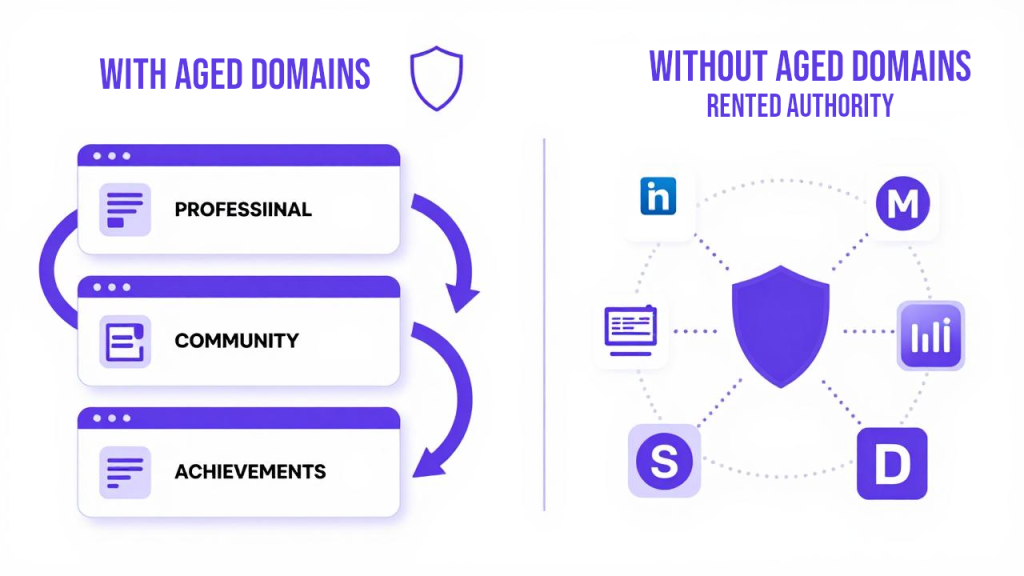
On your oldest or most trusted domain, create three distinct “About” pages, each optimized for a different angle of your identity:
The Professional Anchor. Optimized for “Name Profession” — focused strictly on career history, credentials, industry contributions, and expertise.
The Community Anchor. Optimized for “Name City Volunteer” — focused on local involvement, nonprofits, mentorship, and civic engagement.
The Achievements Anchor. Optimized for “Name Award” or “Name Recognition” — focused on press mentions, honors, milestones, and publications.
Each page links to the others through navigation or footer links, creating a tight internal network that passes link equity. This tells Google your domain is a comprehensive source of truth about you, boosting overall domain authority for name-based searches. Unlike third-party platforms where you rent space, these anchor pages inherit the trust of your aged domain immediately and require no waiting period. They are the stable foundation upon which your entire suppression campaign rests.
Once all pages pass the quality gate, they are packaged into a deployment manifest: a structured list of assets with target query, content, destination URL, and metadata like publication date and schema type. This manifest feeds directly into your deployment automation. You now have ammunition loaded and aimed at every confirmed vulnerability in your search footprint.
Phase 3: Deployment — The Hybrid Velocity Attack
You have your intelligence and your ammunition. Now comes execution. In this phase, we do not just publish. We launch a synchronized, multi-vector attack designed to overwhelm the search index’s dampening mechanisms, deploying counter-content across as many high-trust channels as possible within a compressed time frame, ideally 48 hours.
The Hybrid Strategy: Renting and Owning
For the 90-day push, you cannot rely solely on your own domains. Aged domains are powerful anchors, but they take time to accumulate fresh signals for new pages. To win immediately, combine rented authority with owned infrastructure.
Rented Authority (The Shock Troops) are third-party platforms the search engines trust implicitly and index instantly.
Professional networks. Publish full articles on LinkedIn Pulse and professional bio updates on industry directories. These often rank higher than personal websites because the domain authority is massive.
Content platforms. Post long-form variations on Medium, Substack, or Ghost. Structure them as definitive profiles or thought leadership pieces, not blog posts.
Community Q&A. Answer relevant questions on Quora or niche forums where your name appears naturally. The key here is value. If the answer is helpful, the platform keeps it, and it ranks well.
Code repositories. Host a static site or README on GitHub Pages. Technical queries often pull from these sources due to the high trust associated with developer communities.
Owned Infrastructure (The Standing Army) are your specialized Anchor Pages deployed to your owned domains. Because these live on aged domains, they inherit existing trust immediately. They act as the stable core supporting the more volatile rented assets.
Leveraging Platform-Specific Real Estate
Do not ignore the specific features of these platforms.
The short bio. On Medium or LinkedIn, the author bio is a highly indexed snippet. Write a keyword-dense statement here: “Name is a Profession in City, creator of Project.” Even if links are stripped, the text mention helps the algorithm associate your identity with your projects.
The mini About page. Many platforms allow a dedicated “About” article or pinned post. Treat this as a landing page mirroring your owned Anchor pages, linking deep within the text to your owned domains. This creates a high-authority node that points inward to your ecosystem.
The Burst Deployment Protocol
Timing is the critical variable. If you spread publishing over weeks, negative results will simply re-rank around your new content. You need a burst.
Day 0, recon completion. Finalize the list of vulnerable keywords and generate the corresponding content variations.
Day 1, the launch. Execute the deployment script to publish to all selected platforms within a single day. Morning: push anchor pages to owned domains and submit sitemaps to Google Search Console. Afternoon: publish articles to Medium, LinkedIn, and other platforms. Evening: submit URLs for indexing via ping services or automated notifications.
Day 2, cross-linking. Where platform policies allow, add links between your new properties. Link your LinkedIn article back to your Professional Anchor and your Medium post to your Community Anchor. This creates a web of inter-referencing signals reinforcing the narrative.
Week 1, monitoring. Watch the rankings daily. Shifts should start within 72 to 96 hours as the engines crawl the fresh burst.
Diversity of Signals
The algorithm does not just count links. It evaluates the diversity of sources. A cluster of ten links from the same domain looks suspicious. A cluster of one link each from Medium, LinkedIn, GitHub, a news directory, a podcast show note, and five different owned domains looks like organic consensus. Deploying across a wide variety of platform types signals that your neutral narrative is being corroborated by independent entities, which carries far more weight than a single source repeating the same message.
Handling Platform Constraints
Not every platform plays nice. Some have strict anti-spam filters or require manual review.
For platforms that block automated posting, use their official APIs if available, or browser automation to simulate human interaction patterns with random delays and mouse movements. If a specific platform rejects your content, have a backup list of alternative sites ready. Never let a single rejection halt the deployment. And ensure your generated content respects each platform’s culture: a LinkedIn post sounds professional, a Reddit thread conversational, a GitHub README technical. Your generation pipeline handles these tonal shifts automatically.
Within two to four weeks, the math changes. Data broker listings and negative news articles once dominating Page 1 now compete against a fresh wave of 20 to 50 unique, high-quality, indexed pages. The algorithm, prioritizing freshness and the apparent consensus of diverse sources, demotes the older, static content. The negative results drop to Page 2 or lower, effectively invisible to anyone scanning the first page.
Phase 4: Monitoring and Adjustment — Holding the Ground
The burst deployment buys breathing room, but not permanence. Search algorithms update constantly, re-evaluating rankings based on fresh signals, new back links, and shifting user behavior. Data brokers update their databases on automated schedules too. A negative result you pushed to Page 2 today can creep back to Page 1 next month if you stop reinforcing your position. The 90-day push is a sustained campaign of occupation.
The Weekly Ranking Audit
Your reconnaissance engine transitions into a monitoring role. It runs weekly, querying each target keyword across all monitored engines, recording the ranking position of every URL, both yours and the negative results.
Watch three things. Are your deployed pages holding steady? If your Medium article sits at position three and your Professional Anchor at five, that is stable. Drift to seven or eight signals decay. Is the negative content staying suppressed? You want it at position eleven or lower, firmly on Page 2. If a data broker listing reappears at nine, you have a leak. Are there new threats? Sometimes suppressing one negative result surfaces another that was buried deeper. Catch these before they gain traction.
Responding to Ranking Decay
When a negative result creeps back up, do not panic. Reinforce.
If a result moves from Page 2 to the bottom of Page 1, generate five to ten new content variations targeting that keyword combination and deploy within 24 hours. Fresh signals reset the advantage. The algorithm sees renewed activity around that topic and re-prioritizes your newer content over the static negative page.
If one of your own pages loses rank, diagnose why. Platform policy change? Content flagged as promotional? Sometimes refreshing an existing page — updating the publish date, adding a paragraph, tweaking the meta description — triggers a re-crawl and a ranking boost without creating an entirely new asset.
If a new threat URL appears that your initial recon did not catch, run it through the full pipeline: semantic analysis, content generation, quality gate, deployment.
The Kill Switch: Forcing Re-indexing
When a negative result threatens to return, waiting for natural crawling is too slow. Use Google Search Console, and the equivalent tools for Bing and Yandex, to force the issue.
Log in to Search Console and select your property. Paste the exact URL of your updated page in the inspection bar. Run the inspection, wait for analysis, then click Request Indexing. The engine adds the URL to the priority crawl queue, usually processing it within hours rather than days. Repeat for Bing Webmaster Tools and Yandex Webmaster. This is your emergency brake to ensure fresh content beats aging negative results.
The Checkpoints
At 30 days, expect volatility. Rankings fluctuate as engines test different result configurations. Some pages may spike to position two, drop to eight, then settle in between. This is normal. Only intervene if a negative result holds a Page 1 position for more than a week consecutively.
At 60 days, the dust should be settling. Your deployed content has accumulated enough age and engagement signals to hold rank stably. Negative results should be firmly on Page 2. If they are not, you have a hardened target: one of those high-authority domains that resists standard suppression. Escalate. Increase content density around that specific keyword, seek collaborative placements on other high-trust domains, and consider whether the negative result qualifies for any legal or policy-based removal channels you have not yet exhausted.
At 90 days, evaluate the campaign. Count how many of the top ten results for each target keyword you control versus how many belong to negative sources. If you hold seven or more of the top ten, the campaign is a success. If fewer, identify which keywords still leak and allocate additional generation and deployment resources to those gaps.
Transition to Long-Term Maintenance
At the end of the 90-day push, the emergency is over. What remains is upkeep. Monitoring continues weekly, but the response threshold changes — intervene only when a negative result breaches Page 1. Content generation slows from burst mode to a trickle: perhaps one fresh article per month per keyword cluster, just enough to maintain the freshness signal without appearing manic.
This is where the real war begins. The rented platforms served you well for the quick win, but they are not under your control. A platform policy change, an account suspension, or a quiet algorithmic demotion can erase months of work overnight. Building your own permanent infrastructure ensures the ground you captured stays yours indefinitely.
That is the Micro-Exosphere strategy. A distributed network of owned domains, aged and interlinked, replacing dependence on rented authority. It is the theater-wide play that turns a 90-day skirmish into a permanent occupation. In the next article, I will walk through the architecture: how to acquire and prepare aged domains, how to configure them as mutual back links that pass trust without triggering spam filters, and how to stagger deployments so the network looks organic while serving your defensive needs. You can execute Keyword Hijacking with rented assets for a quick win. But if you want the narrative locked down for the long term, you need the Micro-Exosphere. The battlefield expands in Part II.
For now, know this: Keyword Hijacking: The 90-Day Push to Take Back Your Search Results works because it treats reputation management as what it really is — an asymmetric conflict where speed, volume, and persistence determine the winner. You did not ask permission to take back your search results. You engineered the outcome. And as long as you keep watching the algorithm and reinforcing your position, the narrative stays yours.
Download
The complete Keyword Hijacking code ships as a zipped archive running in its own Docker container. It is fully commented and open sourced so you can modify it to your needs.