The Total Fragmentation Package
If you have been following this year’s calendar, you have already built the foundation. In January, we laid the groundwork with “Flooding your metadata” and “Making Believable Clones to hide yourself” ,” teaching you how to blend into the noise. February challenged you to deploy “Guerrilla Encryption” and honeypots to lure surveillance into dead ends. March focused on “SIGINT Counter-Surveillance,” shielding your physical signals from interception. You have likely already implemented these tactics, securing your data and confusing the trackers. But today, we take the next logical step. We move from a collection of defensive tools to a unified, strategic architecture. This is the “Total Fragmentation Package,” and it is designed not to replace what you have built, but to orchestrate it into a system that is far greater than the sum of its parts.
The limitation of using isolated tools is that they often operate in a vacuum. A script that scrubs metadata might protect a single file, but it does not protect the relationship between your work life, your family life, and your advocacy work. True privacy in 2026 requires more than hiding; it requires the strategic creation of multiple, distinct realities. This article introduces a system where you define your own “compartments” — whether that is your professional role, your family unit, or your activist circle — and assign each a unique, self-consistent digital identity. By doing so, you ensure that even if an adversary compromises one slice of your life, the data they find is useless for profiling the whole. You are no longer just hiding; you are fracturing your digital self into a cloud of uncertainty that renders surveillance algorithms incapable of convergence.
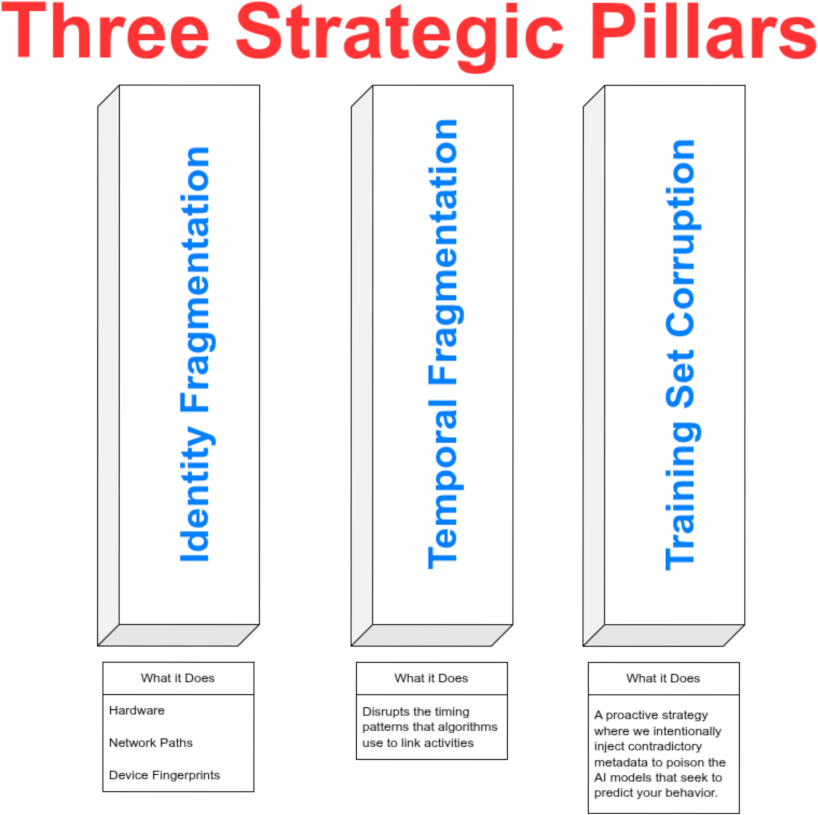
This system rests on three strategic pillars that you have already encountered but will now integrate. The first is Identity Fragmentation, where we use Linux tools to bind specific hardware, network paths, and device fingerprints to specific life contexts, ensuring no cross-contamination. The second is Temporal Fragmentation, which disrupts the timing patterns that algorithms use to link activities, ensuring your “work” hours never accidentally bleed into your “family” hours in the data logs. The third is Training Set Corruption, a proactive strategy where we intentionally inject contradictory metadata to poison the AI models that seek to predict your behavior. Together, these pillars transform your digital footprint from a clear target into a statistical anomaly.
We are moving away from the mindset of a “toolbox” filled with random utilities and toward a “manifest-driven architecture.” In this system, you do not just run a script; you define a compartment manifest — a simple configuration file that tells the system exactly how to behave for that specific context. The system then automatically spins up the necessary virtual machines, routes the traffic through the correct proxy chains, and injects the precise metadata required to maintain that reality. This approach respects the diversity of your life; whether you are a corporate executive, a freelance artist, or a privacy advocate, the system adapts to your unique compartments rather than forcing you into a one-size-fits-all mold.
By adopting this holistic system, you gain a decisive strategic advantage. You stop reacting to surveillance and start dictating the terms of engagement. You force the adversary to waste resources verifying data that is fundamentally broken, while you maintain the clarity and control of your own life. This is the next level of privacy: not just being unseen, but being unclassifiable. Let us begin by defining the architecture of your Total Fragmentation Package and learning how to configure the manifests that will drive your new, segmented realities.
Defining Your Compartments

To build the Total Fragmentation Package, we must first abandon the idea of a single, monolithic digital identity. In the real world, you likely already separate your life into distinct spheres: your professional role, your family responsibilities, your social circles, and perhaps your private advocacy work. The goal of this system is to mirror that reality digitally, ensuring that each sphere operates as a completely isolated ecosystem. We call these isolated ecosystems “Compartments.” A compartment is not just a folder or a browser tab; it is a sovereign digital environment with its own hardware bindings, network routes, temporal rhythms, and metadata signatures. When you activate a compartment, the system creates a temporary reality where only the data relevant to that specific context exists, and it is shielded from all others.
The heart of this architecture is the Compartment Manifest. Think of this as a blueprint or a recipe that tells the system exactly how to construct a specific reality. Instead of hard-coding rules for “Work” or “Home,” the Manifest is a flexible configuration file — typically written in JSON or YAML — that you create for each unique context in your life. This file defines the boundaries of the compartment. It specifies which physical device or virtual machine will host the activity, which network path (Tor, specific VPN, or direct connection) the traffic must take, and what the “truth” of that reality looks like regarding location and time. By separating the definition of the compartment from the tools themselves, the system becomes agnostic. Whether you are configuring a high-risk activist identity or a low-profile professional persona, the underlying engine remains the same; only the Manifest changes.
Let’s look at what a Manifest actually contains to understand its power. A typical Manifest file will declare the Identity Parameters, such as the specific MAC address to spoof, the browser profile to load, and the SIM card or virtual number to use. It will define the Network Topology, instructing the orchestrator to route traffic through a specific chain of proxies or exit nodes that align with the compartment’s geographic needs. Crucially, it will also hold the Metadata Rules, which dictate how files created in this environment are tagged. For example, a “Family” Manifest might instruct the system to embed location data from a suburban neighborhood and timestamps that align with school hours, while a “Work” Manifest might enforce a corporate office location and business-hour activity windows. These rules ensure that the data generated within the compartment is internally consistent, making it indistinguishable from a genuine user of that profile to any outside observer.
The strategic advantage of this Manifest-driven approach is that it allows for infinite scalability and adaptability. You are not limited to three or four compartments; you can create a new one for a specific short-term project, a temporary travel identity, or a specific online community, simply by writing a new Manifest file. When you are done with that context, you can archive or delete the Manifest, and the system will cease to generate data for that identity, effectively erasing that reality from your active footprint. This modularity means that if one compartment is ever compromised, the breach is contained within that specific Manifest’s parameters. The adversary gains access to a single, isolated identity, but the system prevents them from correlating it with your other compartments or your true self.
The Three Strategic Pillars – Enforcing the Reality
Once you have defined your Compartment Manifest, the system must execute the rules to create the isolated reality you have designed. This execution relies on three strategic pillars that work in concert to ensure total fragmentation. These are not just features; they are the enforcement mechanisms that prevent your digital identities from bleeding into one another. The first pillar is Identity Fragmentation, which ensures that the hardware and network signatures of your compartment are distinct and unlinked from your other lives. The second is Temporal Fragmentation, which disrupts the chronological patterns that algorithms use to stitch disparate activities together. The third is Training Set Corruption, the most advanced layer, where we actively degrade the quality of data that surveillance AI uses to build profiles of you. Together, these pillars transform your Linux environment into a dynamic fortress that adapts to your strategic needs.
Identity Fragmentation
The first pillar, Identity Fragmentation, is about creating a unique “body” for each compartment. In a traditional setup, your browser, your network card, and your device all share the same fingerprints, creating a single point of correlation. In the Total Fragmentation Package, the Manifest dictates that each compartment must have its own unique hardware identity. When you activate a compartment, the system automatically spins up a dedicated Virtual Machine or container with a randomized MAC address, a unique CPU signature, and a distinct browser fingerprint. It routes all traffic through a specific network path defined in the Manifest, such as a specific Tor exit node or a dedicated proxy chain. This ensures that even if you are using the same physical laptop, the digital “person” you present to the internet for your “Work” compartment is physically and logically impossible to link to the “Family” compartment. The system enforces strict air-gapping at the software level, ensuring that cookies, cache, and session data never cross the boundary between identities.
Temporal Fragmentation
The second pillar, Temporal Fragmentation, addresses the timeline. Surveillance systems rely heavily on the consistency of time to build behavioral models. They know that a user who logs in at 9 AM, works until 5 PM, and browses social media at 8 PM is likely a single human. To break this, the system uses the Manifest to inject “noise” into the temporal data. For a “Night Shift” compartment, the system might automatically adjust file timestamps to reflect activity during the day, or conversely, make a “Day Job” identity appear inactive during business hours while simulating activity at odd times. This is achieved through automated scripts that modify EXIF data, file system timestamps, and server-side logs before they are ever transmitted. By ensuring that the temporal patterns of each compartment are internally consistent but mutually exclusive with your other lives, you prevent the adversary from constructing a unified timeline of your existence. You become a ghost in the machine, appearing in different places at different times in ways that defy logical correlation.
Training Set Fragmentation
The third and most potent pillar is Training Set Fragmentation. This moves beyond defense into active disruption. Modern surveillance relies on massive datasets to train AI models that predict behavior, location, and intent. If you simply hide your data, the model learns that you are “unknown.” But if you fragment your data across contradictory, false, or noisy metadata streams, you fracture the model’s ability to learn anything useful about you. The Manifest includes rules for fragmenting the data stream. For example, a “Research” compartment might be configured to generate browsing patterns and search queries that paint a picture of someone with interests completely unrelated to your actual work—injecting signals that suggest a hobbyist gardener, a vintage car enthusiast, or a casual gamer. These fragmented signals are embedded into the metadata of your activity logs, creating a profile that is internally consistent but fundamentally misleading. Over time, as the adversary’s system ingests this fragmented data, its confidence in profiling you collapses. The model becomes “confused,” assigning low probability scores to your actual activities and effectively deprioritizing you as a target because you no longer fit any recognizable pattern of interest.
These three pillars are not independent; they are orchestrated by the system to work in harmony. When you launch a compartment, the Identity Pillar sets the stage, the Temporal Pillar sets the clock, and the Training Set Pillar floods the zone with noise. The result is a digital environment that is robust, adaptive, and strategically superior. You are no longer just hiding your tracks; you are actively rewriting the map that the adversary uses to find you.
The Engine – Manifests and Orchestration
Now that we understand the strategic pillars, we must address the mechanism that brings them to life. In a traditional privacy setup, you might manually run a script to change your MAC address, then open a specific browser, then route your traffic through a proxy. This is fragile, prone to human error, and difficult to scale. The Total Fragmentation Package replaces this manual choreography with an automated engine driven by two core components: the Compartment Manifest and the Orchestrator Script. The Manifest is your strategic blueprint, a simple text file that defines the “truth” of a specific compartment, while the Orchestrator is the intelligent conductor that reads that blueprint and configures your Linux system to match it instantly.
Compartment Manifest
The Compartment Manifest is the heart of the system. It is a structured configuration file, typically written in JSON or YAML, that acts as the source of truth for a specific identity. You do not need to be a programmer to create one; it is simply a list of parameters that describe the reality you wish to inhabit. A Manifest file declares the compartment’s name, its purpose, and the specific rules for the three pillars. Under “Identity,” it lists the hardware to emulate, the MAC address to spoof, and the browser profile to load. Under “Network,” it defines the exact chain of proxies or Tor circuits to use. Under “Metadata,” it specifies the geolocation clusters, timestamp ranges, and device signatures to inject. By separating the definition of the compartment from the tools used to execute it, the Manifest makes the system infinitely flexible. You can create a “Work” Manifest, a “Family” Manifest, or a “Project_X” Manifest, and the system will treat them all with equal precision, ensuring no cross-contamination occurs. Each compartment is fire walled.
Orchestrator Script
The Orchestrator Script is the engine that breathes life into the Manifest. Written in Python or Bash, this script acts as the bridge between your strategic intent and the Linux kernel. When you run the command ./orchestrator.py, the script parses the file and executes a sequence of actions. It first isolates the environment, spinning up a fresh Virtual Machine or Docker container with the specified hardware fingerprints. It then configures the network stack, routing traffic through the defined proxy chain and disabling any default routes that could leak your real IP. Next, it applies the metadata rules, injecting the false timestamps and location data into the file system and clipboard before you even begin your work. Finally, it performs a “sanity check,” scanning for any accidental leaks of real-world data before allowing the session to go live. This automation ensures that every time you activate a compartment, the environment is pristine, consistent, and perfectly aligned with your strategy.
--load "Work_Manifest.json"
This architecture offers a profound advantage: consistency and repeatability. Human error is the greatest vulnerability in privacy; forgetting to disable a location service or accidentally logging into a personal account from a work browser can ruin months of careful planning. The Orchestrator eliminates this risk by enforcing the rules of the Manifest every single time. It ensures that the “Work” identity never sees the “Family” identity, and that the “Training Set Fragmentation” rules are applied to every file and packet. You define the strategy in the Manifest, and the system guarantees the execution.
Building Your First Compartment
Now we move from theory to the terminal. This section guides you through setting up your first Compartment Manifest and the basic Orchestrator script on any Linux distribution. You do not need to be a kernel developer to do this; you need only a text editor, a terminal, and a willingness to automate your privacy. We will build a simple but functional “Work” compartment that demonstrates the three pillars: Identity Fragmentation, Temporal Fragmentation, and Training Set Fragmentation.
Step 1: Creating the Manifest
First, create a directory for your new compartment. Open your terminal and run mkdir. Inside this folder, create a file named
~/fragments/work_identitymanifest.json. This file is your blueprint. It will tell the system exactly how to behave. Paste the following structure into the file, adjusting the values to match your specific needs. Notice how we define the “fake” reality: the location is set to a generic business district, the time window is restricted to business hours, and the device signature is randomized.
In this example, the geo_cluster lists coordinates for Paris and London. The system will randomly pick one for any file you create, ensuring your “Work” identity appears to be a frequent traveler between these two hubs, confusing any algorithm trying to pin you to a single location. The interest_tags are used to generate fake search queries or metadata that suggest a professional focus on logistics, further fragmenting the training data.
Step 2: The Orchestrator Script
Next, we need the engine. Create a file named orchestrator.py in the same directory. This Python script will read your Manifest and apply the rules. You will need to install a few dependencies first: sudo apt install python3-pip exiftool. Then, install the Python library for handling JSON:
macchanger qemu-system-x86pip3 install json.
The script logic is straightforward. It loads the Manifest, checks if the required Virtual Machine is running (or starts it), randomizes the MAC address using macchanger, and sets up the proxy chain. Crucially, it defines a function called inject_metadata that runs whenever you save a file. This function uses exiftool to strip real data and inject the fake coordinates and timestamps defined in the Manifest.
Step 3: Running the System
To activate your compartment, you simply run the script with the path to your Manifest: python3 orchestrator.py. The script will output status messages confirming that the MAC address has changed, the proxy chain is active, and the metadata injection hooks are ready. Once the script reports “Ready,” you can open your browser or file manager. Any file you create or edit in this session will automatically be processed by the
--load manifest.jsoninject_training_noise function, ensuring that the data leaving your machine is fragmented and consistent with your “Work” persona.
Step 4: Verification and Safety
Before you trust the system, you must verify it. Open a terminal inside the compartment (or the VM) and run a leak test. Use tools like curl ifconfig.me to check your IP address, ensuring it matches the proxy chain defined in the Manifest. Check the metadata of a test image you just created using exiftool to confirm that the GPS coordinates and timestamps match the fake values in your Manifest, not your real ones. This verification step is critical; it ensures that the “Total Fragmentation Package” is functioning as a closed loop, with no leakage of your true identity.
test.jpg
By following these steps, you have moved from a passive user of privacy tools to an active architect of your own digital reality. You have built a system that automatically enforces your strategy, ensuring that every piece of data you generate is a fragment of a larger, confusing puzzle that only you can solve. In the final section, we will discuss how to scale this system to manage multiple compartments simultaneously and how to automate the rotation of your identities to keep your defenses dynamic.
Flexibility and Scalability
The strength of the Total Fragmentation Package is not in rigid rules, but in its adaptability. Your life does not fit into a single template, and neither does this system. Whether you are managing dozens of research projects, juggling personal and professional identities, or maintaining high-risk activist compartments, the Manifest-driven architecture scales to meet your needs without requiring you to change your strategy.
Consider your research workflow. Each project has unique requirements: different email aliases, different VM operating systems, different network routes, and different geographic locations. The Manifest system handles this effortlessly because each project is simply a different configuration file. Project 01 might use a Debian VM with a Tor exit in Germany, while Project 02 uses a Fedora VM with a proxy chain through Singapore. The Orchestrator does not care about the differences; it simply executes the parameters. This means you can add a new project by writing a new Manifest file, and the system treats it with the same precision as your oldest, most established compartment.
The same flexibility applies to your personal compartments. A “Family” compartment might prioritize convenience and speed, using a direct connection with minimal metadata noise. A “Work” compartment might prioritize consistency, using stable device fingerprints that match a professional profile. A “High-Risk” compartment might prioritize maximum isolation, using ephemeral VMs that are destroyed after every session. All three can run on the same physical machine, managed by the same Orchestrator script, with no cross-contamination between them. The system does not impose a one-size-fits-all solution; it implements the strategy you define.
This scalability extends to the future as well. New surveillance techniques emerge constantly, and new privacy tools are released regularly. Because the Manifest separates the definition of a compartment from the execution of the tools, you can update the Orchestrator script to support new technologies without rewriting your entire strategy. If a new anonymity network becomes available, you simply add support for it in the script, and all your existing Manifests can leverage it by updating a single parameter. This ensures that your fragmentation strategy remains effective over time, adapting to the evolving threat landscape without requiring you to rebuild your infrastructure from scratch.
Conclusion – The Next Level of Privacy Engineering
We began this journey in January with “Digital Camouflage,” learning to blend into the noise. We moved through guerrilla encryption, SIGINT (Signals Intelligence) counter-surveillance, and honeypot deployment. Each month added a layer to your defensive toolkit. But tools alone are not a strategy. Today, with the Total Fragmentation Package, we have transformed those tools into a cohesive system. You now have the ability to architect multiple, isolated digital realities that prevent correlation, degrade surveillance training data, and ensure that even if one compartment is compromised, the rest remain secure.
This is the next level of privacy engineering. You are no longer reacting to surveillance by hiding your tracks. You are proactively designing a digital existence that is fundamentally un-classifiable. The Manifest-driven architecture gives you control over every variable: your hardware fingerprints, your network routes, your temporal patterns, and your metadata signatures. The Orchestrator script automates the execution, ensuring consistency and eliminating human error. And the compartmentalization strategy ensures that your life domains remain separate, protecting your work from your family, your advocacy from your personal life, and your research projects from one another.
The system is designed to grow with you. Add new Manifest files for new projects. Rotate identities on a schedule. Archive completed compartments and destroy them when they are no longer needed. The Total Fragmentation Package is not a destination; it is a framework for continuous adaptation in an environment where surveillance capabilities evolve constantly.
Where to Find the Code
The complete Orchestrator script, along with example Manifest files for common use cases (Work, Family, Research, High-Risk), is available in the zip file.
Final Checklist for Implementation
Before you deploy, ensure you have completed the following:
Install required dependencies:
- macchanger
- exiftool
- qemu-system-x86
- tor
- proxychains-ng
- Create your first Manifest file using the templates in the repository
- Run the Orchestrator in audit mode to verify no leaks before activating
- Test each compartment individually before running multiple simultaneously
- Schedule regular audits to ensure fragmentation rules remain effective
- Backup your Manifest files to an encrypted, offline location