
Making Believable Clones to hide yourself
When I first tackled the problem of digital over-exposure, my tactical article walked you through the basics: flooding every device you own — phone, laptop, smartwatch — with harmless, random traffic so that any single data point became meaningless. In the Tactical Article I just published, we mixed in weather look-ups, dummy map requests, and a steady stream of generic browsing, all timed to look like everyday activity. That “noise-orchestra” gave us a first layer of protection, but it still left a tell-tale signature — a single person’s footprint bouncing around the same handful of locations. It made it harder to track, but it isn’t enough.
Now I’m taking the next step: building digital clones that can travel the world without ever buying a plane ticket. Imagine a virtual version of yourself that wanders through London, Tokyo, and Rio, connects to the exact Wi-Fi networks you’d find at Heathrow, a Paris cafe, or a Sydney airport lounge, and even mimics the subtle rhythms of a real traveler — heart-rate spikes when the seat-belt sign flashes, a brief pause while you wait in a crowded security line, and a quick copy-paste of a hotel reservation link that instantly appears on your phone, laptop, and watch. By stitching together real-time flight-status feeds, authentic Wi-Fi SSIDs, and genuine hotel URLs, the clones create a seamless, multi-device narrative that looks indistinguishable from an actual trip, all in real-time in the correct time-zone.
The payoff is simple: confuse the data brokers. Every piece of information they collect now sits in a thick cloud of plausible, yet fabricated, activity. Their models can’t tell whether you really stood on the Eiffel Tower or just simulated the climb from the comfort of your living room. By seeding the digital dust with these realistic artifacts, you protect your true whereabouts while still enjoying the freedom of a globally connected identity — without ever leaving home. Let’s dive into how you can build your own strategic clone and start living in the digital mist. This is “Opting Out” of the Data Broker ecosystem proactively because it reduces their collection efforts and gives them inaccurate information that looks “real”.
Creating the Illusion
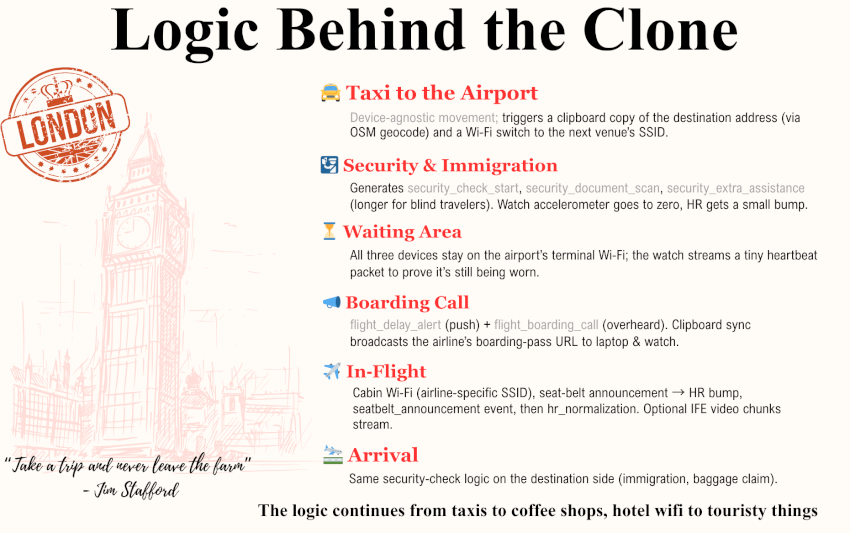
The secret to making a clone feel genuine lies in feeding the data brokers exactly the kinds of signals they already expect from a human traveler, and then layering those signals with enough nuance that no single device ever looks out of place. First, every clone is anchored to a concrete geographic point — an airport, a hotel lobby, a cafe, or a tourist attraction — so the Wi-Fi SSID it connects to matches the venue’s official network name (such as: “Free_WiFi_LHR” at Heathrow, “Delta_SkyClub_WiFi” in a lounge, or “Starbucks_Paris” on a sidewalk). Those SSIDs are pulled from public sources like WiGLE and the airports’ own connectivity pages, so when the clone’s phone, laptop, and watch all report the same hotspot at the same timestamp, the pattern looks exactly like a person who has just stepped off a plane and is checking the gate-display, grabbing a coffee, and opening a map.
Next, the clone mimics the behavioral cadence that a broker’s profiling algorithms look for: a burst of step counts and heart-rate elevation as the clone walks from the baggage claim to the taxi stand, a short lull while it waits in a security line, and a brief pause when the watch’s accelerometer reads zero while the device sits on the conveyor belt. During those pauses the clone still streams a tiny heartbeat-monitor packet, which tells the system that the device is still being worn — even though the wearer is temporarily out of sight.
The illusionist clone also mirrors the information-seeking habits that data brokers love: it issues a weather lookup for the destination city via wettr, pulls a real-time flight-status JSON from AviationStack (including delay minutes, gate changes, and a link to the airline’s boarding-pass page), and then copies that link to the clipboard. The clipboard sync is broadcast instantly to the laptop and watch, so each device logs a clipboard_sync event with the same URL and a matching timestamp. Later, the laptop emits a clipboard_paste event that opens the hotel reservation page, while the watch reads the same URL aloud via its text-to-speech engine. Because the same piece of content appears across three devices, the telemetry forms a tightly coupled chain that looks like a genuine multitasking user.
Finally, the clone sprinkles in human-like noise: occasional voice-assistant queries (“Hey Google, what’s the best sushi place nearby?”), a short TTS audio download for a flight announcement, and a random “seat-belt alert” that nudges the heart-rate up for a minute before normalizing. All of these events are timed with realistic jitter — 30 seconds to a few minutes between actions — so the overall timeline never looks robotic or predictable. By aligning every Wi-Fi connection, step count, heart-rate spike, clipboard operation, and API call with the physical context of the clone’s current venue, the illusion becomes indistinguishable from a real traveler’s digital shadow, drowning the true signal in a sea of believable dust that data brokers can’t easily filter out.
The Logic Flow of the Clones
1️⃣ Initialize a Single Persona
- One source of truth holds the clone’s fingerprint (user-agent strings, screen resolution, language), biometric baselines (heart-rate, step count), battery levels, and the current geographic state (latitude, longitude, time-zone).
- All three devices — phone, laptop, and watch — read from this persona, guaranteeing perfect synchronization.
2️⃣ Load a Destination Pool
- A JSON file lists real cities and their airports, each annotated with:
- Season preference (
winter,summer, orany). - Budget tier (
low,mid,high).
- Season preference (
- Example entries: Nassau (Bahamas, winter, low), Zurich (Switzerland, summer, high), Tokyo (any, mid).
3️⃣ Determine Your Home-Season Context
Many people are what they refer to in Florida as “snow birds”. People like warn tropical breezes when it is cold and take trips in the summer time when it is “summer vacation” so reflecting this in our model makes logical sense.
- The clone queries wettr for the current temperature at your home location.
- Temperatures ≤ 10 °C (50° F)→ “winter”, ≥ 30°C (86°F)→ “summer”, otherwise “shoulder”.
- This label guides the seasonal filter on the destination pool.
4️⃣ Weighted Random Destination Selection
We all have to live “within our means” – let’s reflect that in the clones we make – Put them on a budget.
- The pool is filtered to keep only destinations that match the current season (or are labeled “any”).
- A simple weighting favors low-budget options (weight 3), medium (weight 2), and high (weight 1).
- The clone randomly picks one of the remaining entries, giving you a plausible, season-appropriate next stop.
5️⃣ Pull Real-Time Flight Information
Having generic data will eventually cause suspicion and be easily filtered out. Let’s give them “real” things to look at to make that task as difficult as we can.
- Using the chosen destination’s IATA code, the clone calls AviationStack for a flight that actually departs from the current airport on the desired date.
- The response supplies: flight number, operating airline (handles code-share), aircraft type, scheduled departure/arrival times, gate, and any delay minutes.
- Because the data is live, any real-world delay, cancellation, or gate change automatically appears in the clone’s itinerary—no extra simulation needed.
6️⃣ Update the Persona for the New Leg
- The persona’s geographic fields (lat/lon, time-zone) are swapped to the destination airport.
- Battery levels, heart-rate baseline, and step counter persist, preserving continuity across legs.
- The freshly fetched flight metadata is stored for later use (in-flight Wi-Fi SSID, seat-belt announcement, IFE streaming).
7️⃣ Generate Coordinated Multi-Device Telemetry
For each segment (airport → taxi, hotel stay, in-flight, lounge, etc.) the clone emits a synchronized stream of events:
| Device | Typical Event Chain |
| Phone | Connect to the venue’s Wi-Fi → weather lookup → rideshare request → copy the flight-status URL to the clipboard → push a flight_delay_alert (if delayed) → disconnect for X-ray → pick-up → reconnect → open the hotel reservation page → in-flight Wi-Fi connect → seat-belt announcement (HR bump) → IFE video chunk. |
|
Laptop |
Mirrors the phone’s Wi-Fi hand-off, then fetches the hotel page, streams a short movie, receives the same clipboard sync, and opens the same URL. |
|
Watch |
Stays on the airport Wi-Fi while on the conveyor belt (accelerometer reads near-zero), continues heart-rate monitoring, receives the clipboard sync, and later reads the hotel link aloud. Acts like a tourist. |
All timestamps are expressed in the local time zone of the current venue, and the step-to-distance and HR-to-step guards keep the biometric data realistic.
8️⃣ Overlay on Your Real Daily Activity
• Your genuine work-day traffic (emails, code commits, browsing) continues unchanged on the same devices.
• The clone’s travel-related events are interleaved throughout the day, creating a dense noise-to-signal ratio that drowns out any single identifiable pattern.
• Because the clone uses real URLs, authentic airport Wi-Fi SSIDs, and live flight data, any heuristic that looks for synthetic or impossible values is neutralized.
9️⃣ Required Public Services (sign-up once)
| Service | Purpose | How to obtain |
| AviationStack | Live flight schedules, delays, operating airline (code-share). | Free tier (500 requests/mo) → register and get an API key. |
| WiGLE | Real Wi-Fi SSIDs for airports, lounges, hotels, cafes. | Create a free account → obtain an API token. |
| OpenStreetMap / Nominatim | Geocoding addresses, generating realistic taxi routes. | Public endpoint, respect usage policy (no key needed). |
| TripAdvisor / Google Places (optional) | Real tourist-attraction URLs for clipboard copies. | Free tier via RapidAPI or Google Cloud Places. |
| VPN / Residential Proxy provider | Assigns an IP address that matches the clone’s current city. | Any provider that offers city-level endpoints; store the endpoint URL in the airport record. |
Extra polish you can add
If you want to extend the code that I already have, here are a few ideas so you can try your hand.
- Multi-language voice-assistant queries – let the clone automatically switch its spoken-query language to match the country it’s “visiting” (French in Paris, Japanese in Tokyo). Just pull the locale from the airport’s country code and prepend it to the
voice_assistant_querypayload.
- Real-world missed-connection handling – after you fetch a flight via AviationStack, check the
statusfield. If the API reports canceled or delayed > 2 h, have the clone emit aflight_missed_connectionevent, then automatically re-plan the next leg (pick a new destination or a later flight). This adds genuine disruption without fabricating anything.
- Bluetooth speaker / headphones on the plane – when the clone boards a flight, emit a
bluetooth_pair_startevent (device = watch, target = “airline_headphones”). Follow it with a shortaudio_stream_chunk(e.g., a 30-second movie trailer) to simulate in-cabin entertainment through the paired device.
- Accidental “left-behind” phone – after the hotel-checkout event, insert a random chance (≈ 5 %) that the clone forgets the phone on the pillow. Emit a
device_lostevent, pause all phone-related traffic for a realistic “realization” period (5-10 min), then emit adevice_retrieveevent when the clone walks back to the room, re-connects to the hotel Wi-Fi, and restores the battery level.
- Social-media post stub – a lightweight
social_postevent that includes a short caption and a placeholder image URL (a public domain photo of the Eiffel Tower). It can be tied to a “tourist-spot” clipboard copy so the clone “shares” the attraction after the visit.
- Calendar entry creation – after a successful hotel check-in, generate a
calendar_event_addpayload (title = “Check-in at Hotel X”, start = now, duration = 2 h). This mimics a user adding a reminder on their phone and gives the timeline an extra, believable layer.
- Family-member clone – if you ever want to simulate a second device sharing the same cookie jar (like a child’s tablet), you can spin up a lightweight “secondary persona” that inherits the primary clone’s Wi-Fi and clipboard but has its own battery/HR profile. Not required for your current threat model, but the hook is already in the code base.
Feel free to cherry-pick any of these; each one plugs into the existing event-guard framework with minimal extra code, and they all reinforce the illusion of a fully lived-in-the-world digital persona.
Getting the Code
I’ve packaged the framework as a modular, open-source project that you can tailor to your own needs. All of the components are plain-text files, so you can open them in any editor, add, remove, or edit entries, and immediately see the effect. The repository is distributed as a single ZIP archive; simply download it, unzip, and follow the step-by-step instructions in the README.md to get started. The code is deliberately generic and extensible—feel free to experiment, test, and make it your own.
Final Thoughts
Living amidst the constant hum of our own devices can feel like harmless fun when we generate artificial “clones” that simulate trips to Paris, London, Sydney, and beyond. Yet those synthetic signals serve a serious purpose: they drown out the data streams that corporations, governments, or any opportunistic party might harvest from your real devices. Protecting your privacy is a cornerstone of a safe, autonomous life, and taking proactive steps to obscure your digital footprint is an essential act of freedom. Join me on this year-long journey as we explore practical ways to outwit the “Data Industrial Complex” and preserve the liberties that matter most.

Disclaimer:
This article is for individuals at higher risk or in places that have repressive governments. It is intended to augment freedoms that we all hold dear. I do not advocate anything illegal or immoral be done with this knowledge. Be safe out there.